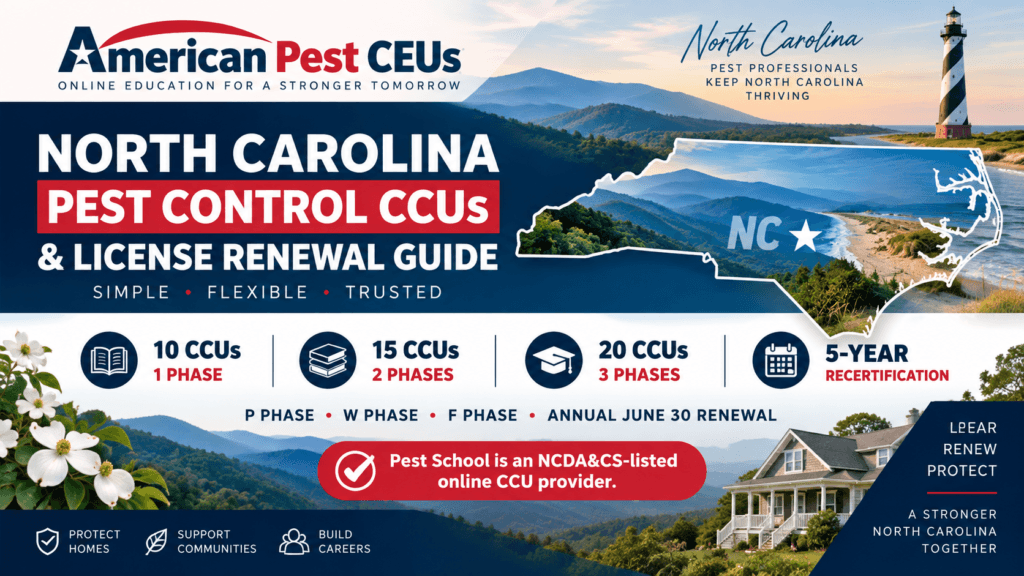
North Carolina Pest Control CCUs & License Renewal Guide
A practical guide to North Carolina structural pest control continuing education, Certified Applicator and Licensee recertification, annual credential renewal, P/W/F phases, and approved online CCU training.
If you are searching for North Carolina pest control CEUs, there is one important terminology difference to understand immediately: North Carolina officially refers to structural pest control continuing education credits as Continuing Certification Units, or CCUs.
That distinction matters because structural pest control professionals in North Carolina operate under a credential system administered by the North Carolina Department of Agriculture & Consumer Services (NCDA&CS).
Certified Applicators and Structural Pest Control Licensees have both an annual credential renewal and a separate five-year recertification requirement. Understanding both timelines can help prevent last-minute compliance problems.
A North Carolina Structural Pest Control Licensee or Certified Applicator holding one phase generally needs at least 10 CCUs, two phases require 15 CCUs, and three phases require 20 CCUs during the five-year recertification period.
Who Regulates Pest Control Licensing in North Carolina?
Structural pest control credentials in North Carolina are administered through the North Carolina Department of Agriculture & Consumer Services Structural Pest Control program.
North Carolina divides structural pest control into three specialized areas known as phases.
Household Pest Control
Includes common household and structural pests such as ants, cockroaches, fleas, rodents, silverfish and similar pests, excluding fumigation.
Wood-Destroying Organisms
Includes termites, powderpost beetles, wood-destroying fungi and other organisms regulated under the state’s W phase.
Fumigation
Covers pesticide applications in which the pesticide controls pests in gaseous form.
How Many North Carolina Pest Control CCUs Are Required?
North Carolina bases the minimum structural pest control recertification total on the number of phases held by the Licensee or Certified Applicator.
At least 5 CCUs must apply specifically to the phase held.
At least 5 CCUs must apply to each of the two phases held.
At least 5 CCUs must apply to each P, W and F phase.
How the Extra Five CCUs Work
After meeting the required five phase-specific CCUs for each phase held, the remaining five CCUs may generally come from any approved structural pest control training category.
North Carolina Has Two Different Renewal Clocks
This is one of the most important concepts for North Carolina pest professionals to understand.
Annual credential renewal and five-year recertification are separate requirements.
Annual Credential Renewal
Structural Pest Control Licensees, Certified Applicators and Registered Technicians must renew their credentials each year. North Carolina’s structural pest control year runs July 1 through June 30.
Five-Year Recertification
Certified Applicators and Structural Pest Control Licensees must also complete the applicable CCU requirements or qualify through the recertification examination route during their five-year cycle.
When Do North Carolina Pest Control Credentials Renew?
NCDA&CS states that structural pest control credentials must be renewed annually to continue performing structural pest control work without interruption.
Renewal packets are generally mailed by May 1, and they must be postmarked on or before June 30.
Current North Carolina Renewal Snapshot
CCUs Must Be Earned Across Multiple Years
North Carolina does not allow every Certified Applicator or Licensee to simply wait until the end of the fifth year and earn all required CCUs at once.
Commercial Certified Applicators
Must complete approved CCUs during at least three different years of the five-year recertification period.
Licensees & Non-Commercial CAs
Must complete approved CCUs during at least four different years of the five-year recertification period.
Even if you earn enough total CCUs, you still need to satisfy the applicable unique-year requirement. Build continuing education into your annual operating calendar rather than treating it as a fifth-year emergency.
Do North Carolina CCUs Carry Over?
No. NCDA&CS states that CCUs earned during one recertification period do not carry forward into the next five-year period.
In addition, repeating the same course during the same five-year period generally counts only once for recertification credit.
Can North Carolina Pest Control CCUs Be Completed Online?
Yes. NCDA&CS maintains a list of approved on-demand structural pest control CCU providers.
Pest School is currently included on the NCDA&CS list of online on-demand CCU course providers.
American Pest CEUs on PestSchool.com
Pest School is listed by NCDA&CS among its online on-demand structural CCU providers.
Before enrolling, confirm the approval and phase credit associated with the specific course you intend to complete.
BROWSE NORTH CAROLINA PEST CONTROL TRAININGRecertification by Examination
Continuing education is not the only available recertification route.
NCDA&CS also allows qualifying Certified Applicators and Licensees to recertify by examination.
During the final year of the five-year cycle, recertification examinations may be taken between January 1 and June 30.
Most professionals who prefer continuing education should track CCUs consistently throughout the five-year period rather than relying on an exam at the end of the cycle.
Registered Technician Requirements in North Carolina
Registered Technicians operate under a different qualification path from Certified Applicators and Licensees.
Before becoming eligible for a Registered Technician card, applicants generally must complete:
Registered Technician cards also renew annually by June 30.
North Carolina Pest Control Renewal Checklist
Before Your Next Renewal
Why Continuing Education Matters for North Carolina Pest Professionals
North Carolina pest professionals work across environments ranging from coastal communities to urban markets and mountain regions.
Continuing education can strengthen knowledge in areas such as pest biology, termite and wood-destroying-organism control, pesticide safety, label compliance, application methods, Integrated Pest Management, equipment, regulations and customer protection.
Continue Your Pest Control Education
Explore approved pest control training through PestSchool.com .
You can also compare North Carolina requirements with our Florida, Georgia, South Carolina and Texas pest control CEU guides.
Building a state-by-state understanding of continuing education can be especially valuable for pest management professionals and companies that operate across multiple states.
Explore pest management education through American Pest CEUs on PestSchool.com and verify which approved courses match your North Carolina credential and structural pest control phase.
BROWSE PEST CONTROL COURSESFrequently Asked Questions About North Carolina Pest Control CCUs
Does North Carolina call pest control continuing education CEUs or CCUs?
North Carolina officially refers to structural pest control continuing education credits as Continuing Certification Units, or CCUs. Many pest professionals still search online using the more general term CEUs.
How many CCUs does a North Carolina Certified Applicator need?
One phase requires a minimum of 10 CCUs, two phases require 15 CCUs, and three phases require 20 CCUs. At least five credits must apply specifically to each phase held.
How often do North Carolina pest control licenses renew?
North Carolina structural pest control credentials renew annually. The structural pest control year runs from July 1 through June 30.
How often do North Carolina Certified Applicators recertify?
Certified Applicators and Structural Pest Control Licensees operate on a five-year recertification cycle while continuing to renew their credential cards annually.
Can North Carolina structural pest control CCUs be completed online?
Yes. NCDA&CS maintains an official list of approved on-demand structural pest control CCU providers, and Pest School is currently included on that list.
Do North Carolina pest control CCUs carry over?
No. CCUs earned during one five-year recertification period do not carry forward into the next recertification period.
What are North Carolina’s structural pest control phases?
North Carolina uses P phase for Household Pest Control, W phase for Wood-Destroying Organisms and F phase for Fumigation.