Georgia Pest Control CEUs & License Renewal Guide
A practical guide to Georgia structural pest control continuing education, Certified Operator recertification, Registered Employee renewal, online CEU limits, and Georgia Department of Agriculture requirements.
Pest management professionals searching for Georgia pest control CEUs need to first understand which credential they hold.
Georgia regulates structural pest control through the Georgia Department of Agriculture and separates structural pest professionals into several types of credentials, including Certified Operators and Registered Employees.
The continuing education requirements are different for each credential, which makes it important to know your certification category, renewal period, and the amount of approved training required.
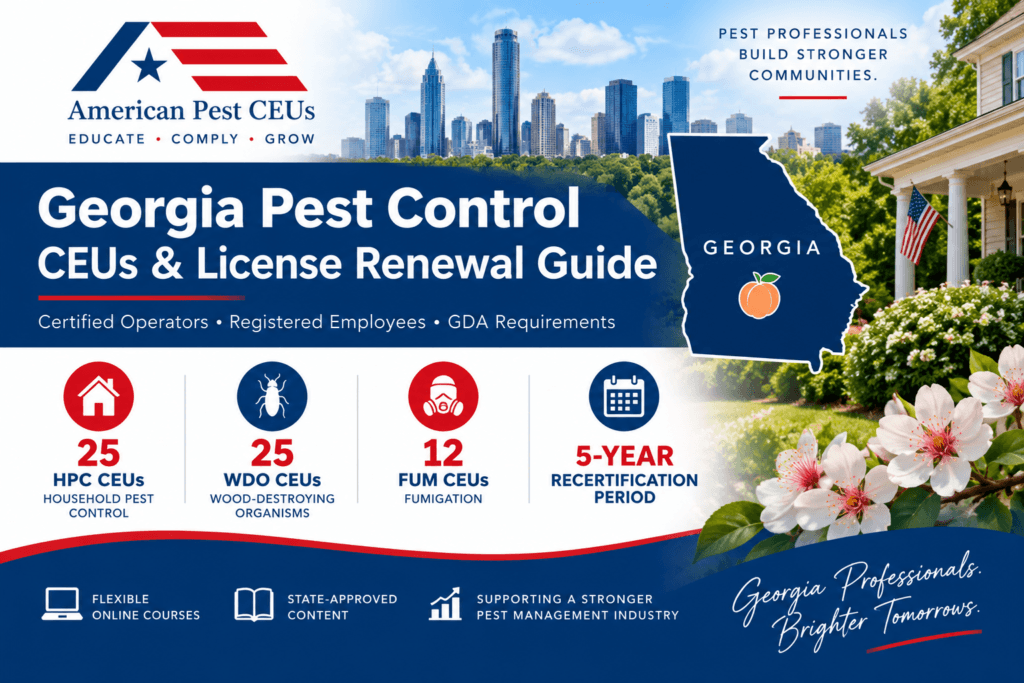
Georgia Certified Operators generally need 25 approved CEUs in Household Pest Control, 25 CEUs in Wood-Destroying Organism Control, or 12 CEUs in Fumigation during the applicable five-year recertification period. Registered Employees use a separate two-year training cycle with lower CEU totals.
Who Regulates Pest Control Licensing in Georgia?
Structural pest control licensing, certification, employee registration, and continuing education in Georgia are administered by the Georgia Department of Agriculture.
The Georgia Structural Pest Control Commission establishes requirements involving certification, registration, examinations, recertification, training, and structural pest management practices.
Company License
Businesses providing structural pest control for hire must maintain the appropriate company licensing.
Certified Operator
A professional credential for individuals who have demonstrated the required experience, knowledge, training, and examination competency.
Registered Employee
Structural pest control employees performing or soliciting pest control services must satisfy Georgia employee registration requirements.
Georgia Certified Operator CEU Requirements
Georgia Certified Operators are subject to a five-year recertification period.
Operators may maintain certification through approved continuing education or by completing the applicable reexamination requirements.
Approved CEUs required for HPC recertification.
Approved CEUs required for WDO recertification.
Approved CEUs required for fumigation recertification.
Georgia’s 90-Day Rule Matters
Certified Operator recertification training must be completed within the applicable five-year period and far enough in advance to satisfy Georgia’s requirement that recertification be completed before the end of the certification period. Professionals should not wait until the final weeks before expiration to finish CEUs.
Georgia Structural Pest Control Categories
Georgia structural pest professionals may operate in one or more regulated pest control categories.
Fumigation
Household Pest Control
Wood-Destroying Organism Control
Honey Bee Control and Removal
Honey Bee Control and Removal has separate certification requirements, so professionals holding that credential should verify the rules specific to HBR rather than assuming the standard HPC, WDO, or fumigation requirements apply.
Georgia Registered Employee CEU Requirements
Georgia Registered Employees use a different continuing education schedule from Certified Operators.
Registered Employees are generally re-registered on a two-year cycle.
When Do Georgia Registered Employee CEUs Need to Be Completed?
Georgia’s Registered Employee training period begins March 1 and ends February 28 of odd-numbered years.
Registered Employee cards expire on June 30 of odd-numbered years and must be renewed before expiration.
Registered Employee CEUs must be completed during the applicable training period. The later June 30 card expiration date does not mean CEUs can necessarily be postponed until June.
Can Georgia Pest Control CEUs Be Completed Online?
Yes. Georgia recognizes approved computer-based structural pest control training, but there are limits on how much computer-based training may count toward recertification or re-registration.
Certified Operators
HPC: Up to 10 computer-based credits
WDO: Up to 10 computer-based credits
Fumigation: Up to 5 computer-based credits
Registered Employees
HPC: Up to 4 computer-based credits
WDO: Up to 4 computer-based credits
Fumigation: Up to 1 computer-based credit
Georgia removed its previous conference and workshop attendance credit limit effective April 1, 2025. Computer-based training limits, however, still apply.
Georgia Pest Control License Renewal Dates
Georgia structural pest control credentials are not prorated.
Structural pest control cards generally expire on June 30 of odd-numbered years and must be renewed before that date.
Certified Operators should remember that license renewal and five-year recertification are related but are not exactly the same concept. A professional may renew a credential during the biennial cycle while also being responsible for meeting a longer five-year recertification requirement.
Georgia Structural Pest CEUs vs. Pesticide Applicator CEUs
Georgia pest professionals should also avoid confusing structural pest certification with the state’s separate pesticide applicator licensing program.
Georgia commercial pesticide applicators use separate pesticide recertification categories. Depending on the licensed category, commercial applicators generally need either 6 or 10 recertification credits per category during the applicable licensing period.
Private pesticide applicators generally need 3 recertification credits.
A structural pest control CEU is not automatically interchangeable with a pesticide applicator recertification credit. Always verify the exact Georgia credential and category attached to the course approval.
How to Prepare for Georgia Pest Control License Renewal
Georgia Renewal Checklist
What Should Georgia Pest Control Continuing Education Cover?
Strong continuing education should do more than satisfy a licensing requirement.
Pest biology and identification.
Labels, safe use, and environmental protection.
Equipment, techniques, and calibration.
Pest management laws, rules, and compliance.
Inspection, prevention, and integrated control strategies.
Changes in pest management tools and methods.
More Pest Control CEU Resources
Review our Florida Pest Control CEUs and License Renewal Guide .
Read our Texas Pest Control CEUs and Pesticide License Renewal Guide .
Learn more in our Pest Control CEUs and License Renewal Guide .
You can also explore our Online Pest Control Courses and CEUs Guide .
American Pest CEUs provides professional pest management education designed to help pest professionals strengthen technical knowledge and stay informed about continuing education requirements.
EXPLORE PEST CONTROL EDUCATIONFrequently Asked Questions About Georgia Pest Control CEUs
How many CEUs does a Georgia Certified Operator need?
Georgia Certified Operators currently need 25 approved CEUs for Household Pest Control, 25 for Wood-Destroying Organism Control, or 12 for Fumigation during the applicable five-year recertification period.
How many CEUs does a Georgia Registered Employee need?
Registered Employees currently need 8 approved credits for Household Pest Control, 8 for Wood-Destroying Organism Control, or 3 for Fumigation during the applicable two-year registration period.
Can Georgia pest control CEUs be taken online?
Georgia allows approved computer-based structural pest control training, but limits apply to how many computer-based credits may be counted toward recertification or re-registration.
When do Georgia structural pest control licenses expire?
Georgia structural pest control cards generally expire June 30 of odd-numbered years and must be renewed before expiration.
What are Georgia’s main structural pest control categories?
Georgia structural pest control categories include Fumigation, Household Pest Control, Wood-Destroying Organism Control, and Honey Bee Control and Removal.
Are Georgia structural pest CEUs the same as pesticide applicator CEUs?
No. Georgia structural pest credentials and pesticide applicator licenses use separate certification and recertification systems. Professionals should verify which license and category a course is approved for before relying on the credit.
Georgia Pest Control CEUs & License Renewal Guide
A practical guide to Georgia structural pest control continuing education, Certified Operator recertification, Registered Employee renewal, online CEU limits, and Georgia Department of Agriculture requirements.
Pest management professionals searching for Georgia pest control CEUs need to first understand which credential they hold.
Georgia regulates structural pest control through the Georgia Department of Agriculture and separates structural pest professionals into several types of credentials, including Certified Operators and Registered Employees.
The continuing education requirements are different for each credential, which makes it important to know your certification category, renewal period, and the amount of approved training required.
Georgia Certified Operators generally need 25 approved CEUs in Household Pest Control, 25 CEUs in Wood-Destroying Organism Control, or 12 CEUs in Fumigation during the applicable five-year recertification period. Registered Employees use a separate two-year training cycle with lower CEU totals.
Who Regulates Pest Control Licensing in Georgia?
Structural pest control licensing, certification, employee registration, and continuing education in Georgia are administered by the Georgia Department of Agriculture.
The Georgia Structural Pest Control Commission establishes requirements involving certification, registration, examinations, recertification, training, and structural pest management practices.
Company License
Businesses providing structural pest control for hire must maintain the appropriate company licensing.
Certified Operator
A professional credential for individuals who have demonstrated the required experience, knowledge, training, and examination competency.
Registered Employee
Structural pest control employees performing or soliciting pest control services must satisfy Georgia employee registration requirements.
Georgia Certified Operator CEU Requirements
Georgia Certified Operators are subject to a five-year recertification period.
Operators may maintain certification through approved continuing education or by completing the applicable reexamination requirements.
Approved CEUs required for HPC recertification.
Approved CEUs required for WDO recertification.
Approved CEUs required for fumigation recertification.
Georgia’s 90-Day Rule Matters
Certified Operator recertification training must be completed within the applicable five-year period and far enough in advance to satisfy Georgia’s requirement that recertification be completed before the end of the certification period. Professionals should not wait until the final weeks before expiration to finish CEUs.
Georgia Structural Pest Control Categories
Georgia structural pest professionals may operate in one or more regulated pest control categories.
Fumigation
Household Pest Control
Wood-Destroying Organism Control
Honey Bee Control and Removal
Honey Bee Control and Removal has separate certification requirements, so professionals holding that credential should verify the rules specific to HBR rather than assuming the standard HPC, WDO, or fumigation requirements apply.
Georgia Registered Employee CEU Requirements
Georgia Registered Employees use a different continuing education schedule from Certified Operators.
Registered Employees are generally re-registered on a two-year cycle.
When Do Georgia Registered Employee CEUs Need to Be Completed?
Georgia’s Registered Employee training period begins March 1 and ends February 28 of odd-numbered years.
Registered Employee cards expire on June 30 of odd-numbered years and must be renewed before expiration.
Registered Employee CEUs must be completed during the applicable training period. The later June 30 card expiration date does not mean CEUs can necessarily be postponed until June.
Can Georgia Pest Control CEUs Be Completed Online?
Yes. Georgia recognizes approved computer-based structural pest control training, but there are limits on how much computer-based training may count toward recertification or re-registration.
Certified Operators
HPC: Up to 10 computer-based credits
WDO: Up to 10 computer-based credits
Fumigation: Up to 5 computer-based credits
Registered Employees
HPC: Up to 4 computer-based credits
WDO: Up to 4 computer-based credits
Fumigation: Up to 1 computer-based credit
Georgia removed its previous conference and workshop attendance credit limit effective April 1, 2025. Computer-based training limits, however, still apply.
Georgia Pest Control License Renewal Dates
Georgia structural pest control credentials are not prorated.
Structural pest control cards generally expire on June 30 of odd-numbered years and must be renewed before that date.
Certified Operators should remember that license renewal and five-year recertification are related but are not exactly the same concept. A professional may renew a credential during the biennial cycle while also being responsible for meeting a longer five-year recertification requirement.
Georgia Structural Pest CEUs vs. Pesticide Applicator CEUs
Georgia pest professionals should also avoid confusing structural pest certification with the state’s separate pesticide applicator licensing program.
Georgia commercial pesticide applicators use separate pesticide recertification categories. Depending on the licensed category, commercial applicators generally need either 6 or 10 recertification credits per category during the applicable licensing period.
Private pesticide applicators generally need 3 recertification credits.
A structural pest control CEU is not automatically interchangeable with a pesticide applicator recertification credit. Always verify the exact Georgia credential and category attached to the course approval.
How to Prepare for Georgia Pest Control License Renewal
Georgia Renewal Checklist
What Should Georgia Pest Control Continuing Education Cover?
Strong continuing education should do more than satisfy a licensing requirement.
Pest biology and identification.
Labels, safe use, and environmental protection.
Equipment, techniques, and calibration.
Pest management laws, rules, and compliance.
Inspection, prevention, and integrated control strategies.
Changes in pest management tools and methods.
More Pest Control CEU Resources
Review our Florida Pest Control CEUs and License Renewal Guide .
Read our Texas Pest Control CEUs and Pesticide License Renewal Guide .
Learn more in our Pest Control CEUs and License Renewal Guide .
You can also explore our Online Pest Control Courses and CEUs Guide .
American Pest CEUs provides professional pest management education designed to help pest professionals strengthen technical knowledge and stay informed about continuing education requirements.
EXPLORE PEST CONTROL EDUCATIONFrequently Asked Questions About Georgia Pest Control CEUs
How many CEUs does a Georgia Certified Operator need?
Georgia Certified Operators currently need 25 approved CEUs for Household Pest Control, 25 for Wood-Destroying Organism Control, or 12 for Fumigation during the applicable five-year recertification period.
How many CEUs does a Georgia Registered Employee need?
Registered Employees currently need 8 approved credits for Household Pest Control, 8 for Wood-Destroying Organism Control, or 3 for Fumigation during the applicable two-year registration period.
Can Georgia pest control CEUs be taken online?
Georgia allows approved computer-based structural pest control training, but limits apply to how many computer-based credits may be counted toward recertification or re-registration.
When do Georgia structural pest control licenses expire?
Georgia structural pest control cards generally expire June 30 of odd-numbered years and must be renewed before expiration.
What are Georgia’s main structural pest control categories?
Georgia structural pest control categories include Fumigation, Household Pest Control, Wood-Destroying Organism Control, and Honey Bee Control and Removal.
Are Georgia structural pest CEUs the same as pesticide applicator CEUs?
No. Georgia structural pest credentials and pesticide applicator licenses use separate certification and recertification systems. Professionals should verify which license and category a course is approved for before relying on the credit.